

As the end of your holiday year gets closer, it’s worth checking how much annual leave your staff still have left.
Unused annual leave isn’t necessarily a problem. But if someone has a lot of leave still to take, spotting it early gives you more time to work out what needs to happen next.
What you’ll learn
By the end of this article, you’ll understand:
- what to do if staff have lots of annual leave left
- how much remaining leave you should be concerned about
- how to avoid a rush of holiday requests towards the end of the year
- when unused annual leave can be carried over
- how to keep track of remaining leave
What should employers do about unused annual leave?
A high balance doesn’t necessarily mean you have a problem. What matters is how much time someone has left to use it and what the situation looks like across the rest of the team.
Here’s what we’d suggest checking.
1. Check how much annual leave everyone has left
Start by checking everyone’s remaining entitlement.
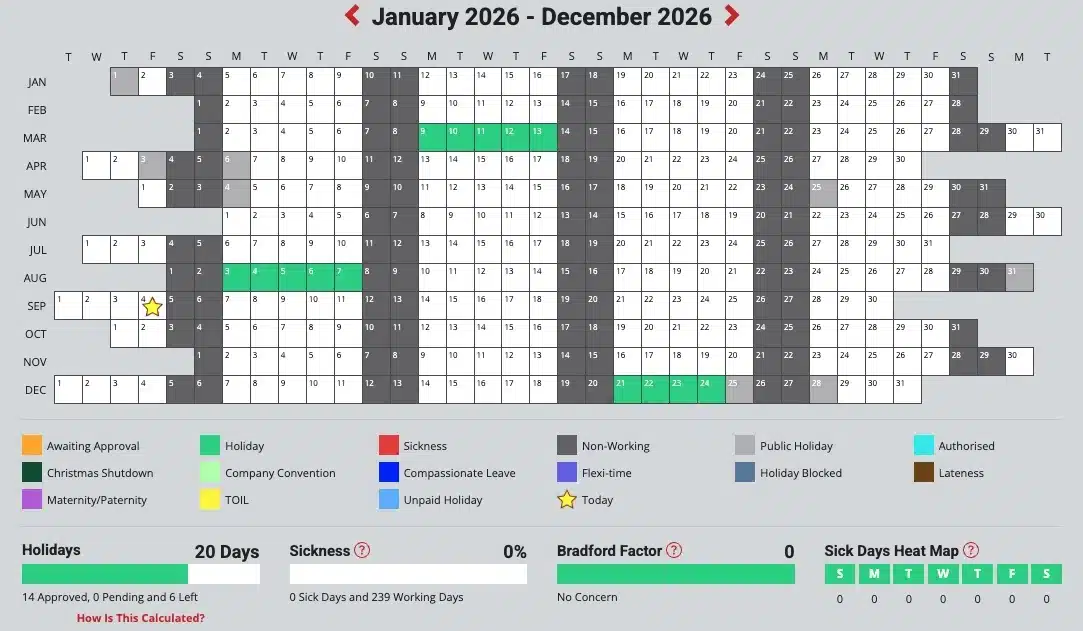
If you use The Holiday Tracker, an employee’s remaining entitlement is updated as holidays are booked, so you can see how many days they’ve used and how many they still have left to book.
2. Look at how much time they have left to use it
Eight days of annual leave remaining might not be a problem if there are still six months left in your holiday year.
Eight days left with only six weeks to go is a different matter.
So the number of days someone has left doesn’t tell you everything. You also need to think about how long they have left to use them.
There isn’t a set amount of annual leave that someone should have used by a particular point in the year. Some people spread their holidays throughout the year, while others save a large chunk for a longer break.
And, of course, not every business has a January to December holiday year.
The important question is whether staff have enough time and opportunity to use the leave they have left.
3. Look at the wider team
One employee with eight days of annual leave left might be fairly easy to accommodate.
If four people in the same team each have eight days left, that’s potentially 32 days of annual leave to fit in before the end of your holiday year.
So don’t look at each balance in isolation.
Check who else has leave remaining, who’s already due to be away and whether you have particularly busy periods coming up.
Having a clear view of the team calendar can help you see where requests might overlap and where you may need to plan ahead.
4. Talk to employees early
If someone has a lot of leave remaining, start with a conversation.
They may already be thinking about when they’d like to take it. Or they may not have realised quite how much they have left.
If they don’t have plans, an early reminder gives them time to think about when they could take their leave rather than feeling under pressure as the end of the holiday year approaches.
The earlier you have that conversation, the more options you both have.
Employers also have a legal responsibility to make sure workers can take the holiday they’re entitled to, so it’s important not to leave these conversations until the last minute.
5. Make a plan
If someone does need to use more of their annual leave, don’t let the conversation be the end of it.
Depending on the situation, you might:
- encourage them to start booking some of their remaining leave
- identify periods when it would be easier for them to take time off
- remind the wider team to check their balances too
- plan cover in advance
- check whether any leave can be carried over
- make a note to check remaining balances again later
The aim isn’t to get everyone’s balance down to a particular number. It’s to make sure there’s enough time for people to take their leave without creating problems at the end of the year.
Can employees carry unused annual leave over?
Yes, in some cases employees can carry unused annual leave into the next holiday year.
Employers may agree to allow employees to carry over some of their holiday. For example, an employment contract might allow employees to carry over a certain number of days each year.
There are also situations where employees have a legal right to carry holiday over. These include certain cases involving long-term sickness or statutory leave, such as maternity leave.
So before deciding what happens to unused leave, check your own holiday policy or agreements, as well as the current rules on statutory holiday.
If you use The Holiday Tracker, you can enable the Carry Over function and set the maximum amount of leave employees can carry into the next holiday year, making it easy to manage alongside their normal entitlement.
Further information:
How often should employers check annual leave balances?
There’s no single date that works for every business.
If your holiday year runs from January to December, checking towards the end of summer or in early autumn gives you time to spot potential problems before the final few months of the year.
But you don’t need to make this an annual job.
Checking remaining entitlement periodically throughout your holiday year means you’re less likely to be surprised by a large balance towards the end.
If you use The Holiday Tracker, the Annual Report gives you a quick way to see everyone’s entitlement and remaining leave in one place.
Do employers need to keep annual leave records?
Yes.
Since 6 April 2026, employers have been required to keep records relating to annual leave and holiday pay.
These include records of holiday taken, holiday carried over from previous years, holiday pay and payments made instead of holiday, where applicable. Employers must keep these records for at least six years.
You can find the full requirements in the ACAS guidance on keeping holiday records.
A quick unused annual leave checklist
If you’ve spotted someone with a high balance:
- Check how much annual leave they have remaining.
- Look at how much time they have left to use it.
- Check the situation across the rest of the team.
- Talk to them about their plans.
- Agree what needs to happen next.
- Check again later.
You don’t necessarily need to do anything just because someone has a high balance.
The important thing is knowing about it while there’s still plenty of time to plan.
Make the next check easier
Checking unused annual leave is much simpler when you don’t have to piece the information together first.
With The Holiday Tracker, remaining entitlement is updated as holidays are booked, so you can see how much leave each employee has used and how much they have left.
You can also see who’s already off before approving another request, and use the Annual Report to see everyone’s entitlement and remaining leave in one place.
So whether you’re checking in September, December or halfway through your holiday year, the information is already there when you need it.
Try The Holiday Tracker free for 7 days
